
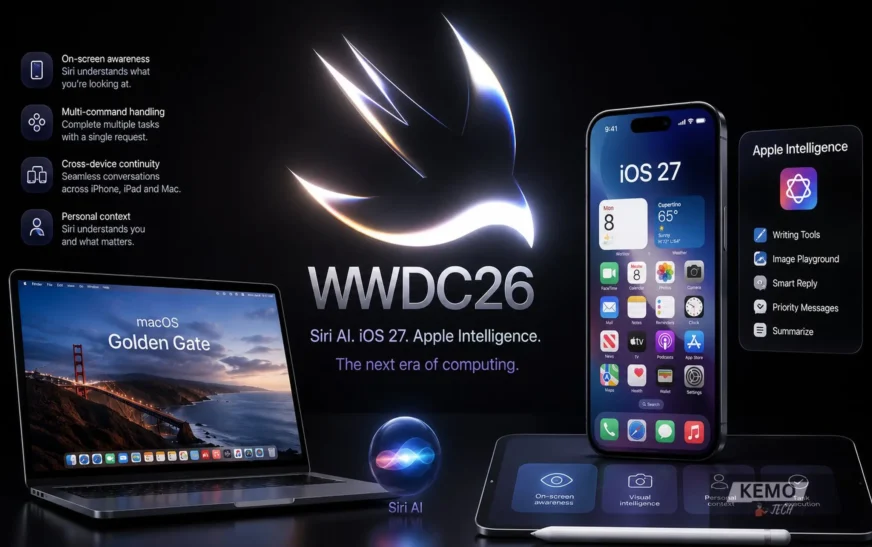
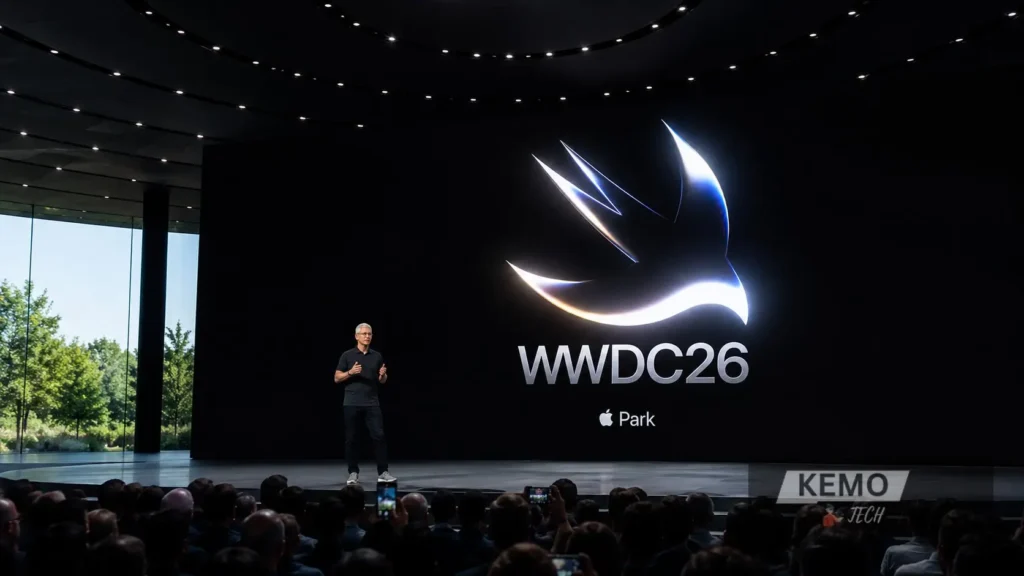
Apple spent years facing criticism for falling behind rivals in the artificial intelligence race. At WWDC 2026, the company finally delivered its strongest response yet, unveiling a sweeping range of AI-powered features and software upgrades across its ecosystem. Held on June 8 at Apple Park in Cupertino, California, the event showcased Apple’s vision for the next generation of computing, with artificial intelligence taking center stage.
From a completely rebuilt Siri powered by Apple’s new Apple Foundation Models and developed through its collaboration with Google, to iOS 27, macOS Golden Gate, expanded Apple Intelligence features, enhanced parental controls and platform-wide software upgrades, WWDC 2026 showcased Apple’s most ambitious AI strategy to date. The event signalled a major shift in the company’s software roadmap as artificial intelligence becomes increasingly central to the Apple ecosystem. Here’s everything Apple announced — and what it means for consumers, developers and the future of Apple’s products.
WWDC 2026 Highlights
- Apple unveiled a completely rebuilt Siri powered by Apple Foundation Models.
- iOS 27 introduces AI-powered productivity, photo editing, and search features.
- macOS Golden Gate becomes the first Mac release to fully embrace Apple’s new AI strategy.
- Apple Intelligence expands across Photos, Messages, Mail, Safari and Home.
- New parental controls give families greater control over children’s digital experiences.
- Tim Cook delivered his final WWDC keynote before handing leadership to John Ternus.
Tim Cook’s Final WWDC
WWDC 2026 also marked a significant moment in Apple’s history. Tim Cook delivered his final WWDC keynote as Apple CEO before handing leadership to John Ternus on September 1, 2026. While the event focused on artificial intelligence and software innovation, Cook’s farewell appearance added extra significance to one of Apple’s most important developer conferences in recent years.
A New AI Era Begins for Apple
WWDC 2025 was Apple’s design year. Liquid Glass — the translucent, frosted-glass visual language — rolled out across all platforms and received a decidedly mixed reception from users who found it harder to read in bright conditions.
WWDC 2026 Was Apple’s Most AI-Focused Event To Date
For two years, Apple had been under pressure from investors, developers and users to demonstrate that it could compete with OpenAI, Google and Anthropic in the AI race. The company’s previous AI efforts had been widely criticised: Siri remained less capable than competitors, Apple Intelligence features were delayed, and the broader AI roadmap felt fragmented.
WWDC 2026 was Apple’s answer. The structure of the keynote told the story — leading with software fixes before features, framing a rebuilt Siri as one of many improvements rather than an isolated launch, and weaving AI throughout every platform announcement. The message was clear, Artificial intelligence is now central to Apple’s software strategy.
Here Is Everything That Was Announced
1. Siri Gets Its Biggest Update Yet
The headline announcement of WWDC 2026 was Siri AI — a complete rebuild of Apple’s voice assistant powered by Apple Foundation Models and developed through Apple’s collaboration with Google.
The new Siri is unrecognisable from its predecessor. It has been rebuilt with deep, system-wide understanding of personal context and on-screen awareness — meaning it does not just respond to commands, it understands what is on your screen, what apps you are using, and what you are trying to accomplish. To understand how AI assistants like Siri work under the hood, our guide on what are AI tools explains the technology in plain English.
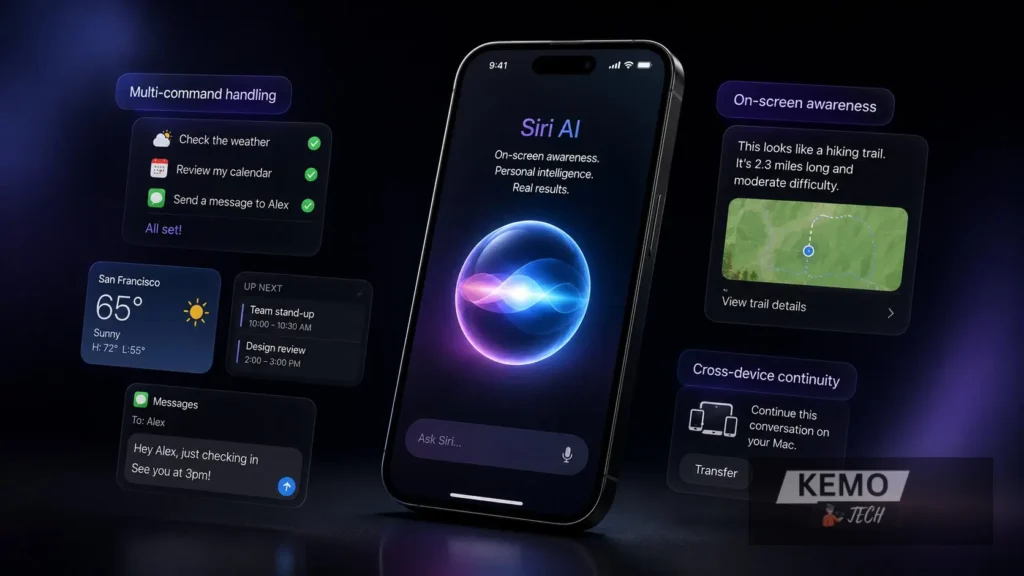
Key Siri AI capabilities announced:
On-Screen Awareness: Siri can see and understand what is on your screen in real time. Looking at a photo of your garden? Ask Siri for planting advice. Viewing a festival schedule? Ask Siri to add your chosen performances to your calendar automatically.
Multi-Command Handling: The new Siri can handle multiple commands in a single request. You can ask Siri to check the weather, review your calendar for the day and send a text message all in one instruction — and it will execute all three.
Cross-Device Continuity: A dedicated Siri app is now available across iPhone, iPad and Mac. You can start a conversation with Siri on your iPhone and pick it up seamlessly on your Mac, with full context preserved.
Visual Intelligence in Camera: You can ask Siri questions about what your iPhone camera is seeing in real time — pointing your camera at something and asking Siri to explain, identify or act on it.
Voice Dictation Improvements: Major improvements to voice dictation across all platforms, making it faster, more accurate and more context-aware.
Siri AI is powered by Apple Foundation Models, which combine on-device intelligence with cloud-based processing through Apple’s Private Cloud Compute architecture. Apple says the new Siri delivers significantly improved reasoning, contextual understanding and task completion capabilities.
How Siri AI Is Powered
Craig Federighi, Apple’s Senior Vice President of Software Engineering, described the vision: “We see Siri not as a separate chatbot, but rather as an integral but conversational tool that you use in the moment, deeply integrated into everything.”
EU Regional Exception
There is one important regional exception. EU iPhone and iPad users will not receive Siri AI at launch due to compliance requirements under the Digital Markets Act, which requires Apple to provide third-party AI assistants the same deep system access as its own tools. Mac, Apple Watch and Vision Pro users in the EU will receive it.
2. What’s New in iOS 27 for iPhone
iOS 27 is the biggest iPhone software update in several years. It supports every device that ran iOS 26, meaning iPhone 11 and later will all receive the upgrade.
Performance improvements are a genuine highlight — Apple is promising up to 30% faster app launches across supported devices, which represents a meaningful quality-of-life improvement even on older hardware.
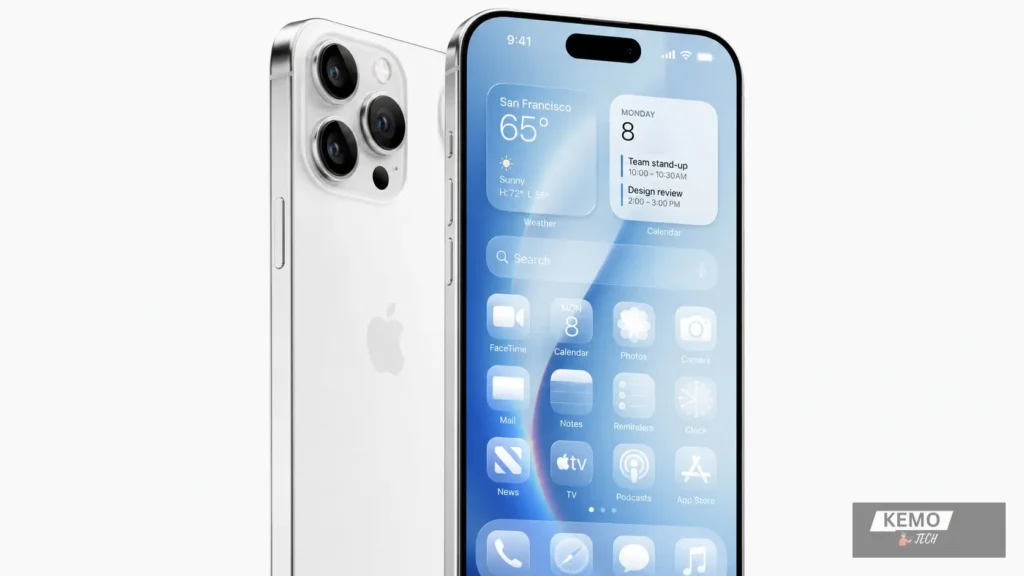
Key iOS 27 features:
Siri AI Integration: The new Siri is deeply embedded throughout iOS 27, accessible from any screen and aware of context across all apps.
Spatial Reframing in Photos: A new AI-powered photo editing feature that allows users to make complex edits — including reframing, subject isolation and scene adjustments by simply describing the change they want in natural language.
Safari Tab Organisation: A new “organise tabs” feature uses AI to automatically group browser tabs by topic — shopping, travel, work and so on reducing tab clutter intelligently.
Safari Notify Me: Users can tell Safari to monitor a specific webpage for a change — a price drop, a ticket going on sale, a new post and receive a notification when that change occurs.
Improved Spotlight Search: Core search technologies have been rebuilt from the ground up, with Siri AI now integrated into Spotlight to deliver faster, more intelligent results.
AirPods Customisable EQ: iOS 27 introduces a customisable equaliser for AirPods, allowing users to tune their audio profile precisely.
App Store Enhancements: Richer developer tools for product pages, a redesigned Asset Library and new creative assets for app listings.
Developer betas of iOS 27 are available now. Public betas arrive in July, with the full release shipping this autumn alongside new iPhone hardware.
Apple Expands Its Intelligence Features
Apple Intelligence — the broader AI platform that powers features across Photos, Messages, Mail and more — received significant expansion at WWDC 2026.
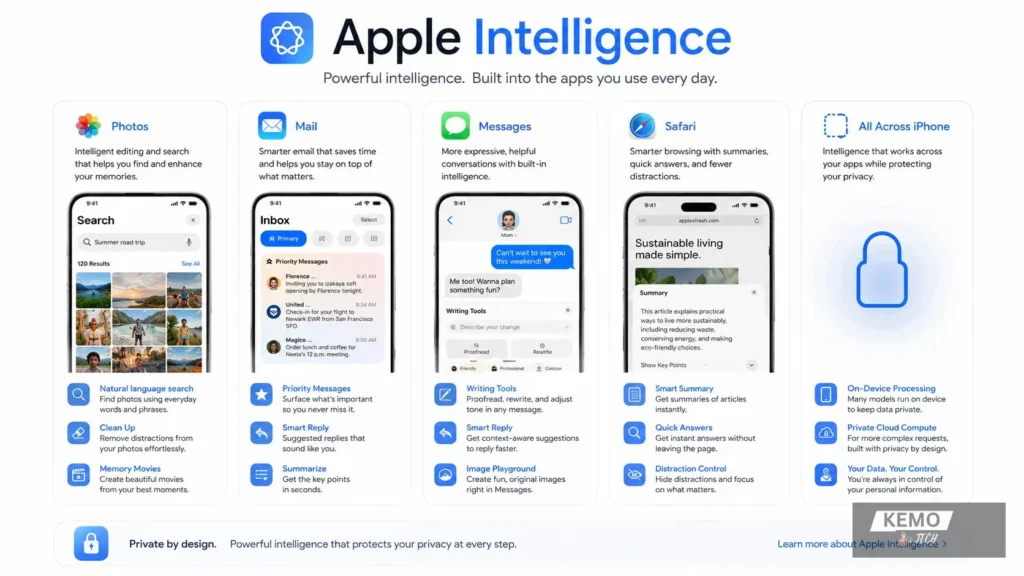
New Apple Intelligence features include:
Advanced Photo Editing: Users can describe complex photo edits in natural language and Apple Intelligence will execute them. This goes beyond simple filters — users can describe scene changes, lighting adjustments and compositional edits.
Home App Security Camera Intelligence: iCloud Plus subscribers gain Apple Intelligence support for compatible home security cameras, enabling smarter motion detection, facial recognition and alert filtering.
Cross-App Context Awareness: Apple Intelligence now operates across apps, understanding context from one application and applying it in another — for example, pulling information from an email into a calendar event automatically.
Private Cloud Compute: Apple continued to emphasise its Private Cloud Compute infrastructure, which processes AI requests on Apple’s own servers using on-device verification, ensuring user data is not accessible to Apple or third parties. This is Apple’s key privacy differentiator against competitors.
Usage Limits: Some AI features, including image generation, carry daily usage limits. An active iCloud Plus subscription raises those limits.
Apple’s strategy is clear: On-device AI plus Private Cloud Compute, positioned against OpenAI, Google and Anthropic. For alternatives beyond Apple, see our guide to the best AI tools for beginners. Apple is betting that privacy-preserving AI will be a meaningful competitive advantage as concerns about data handling grow.
4. macOS 27: Golden Gate
macOS 27 is officially named Golden Gate — continuing Apple’s tradition of naming Mac operating systems after California landmarks, this time referencing the iconic strait near San Francisco.
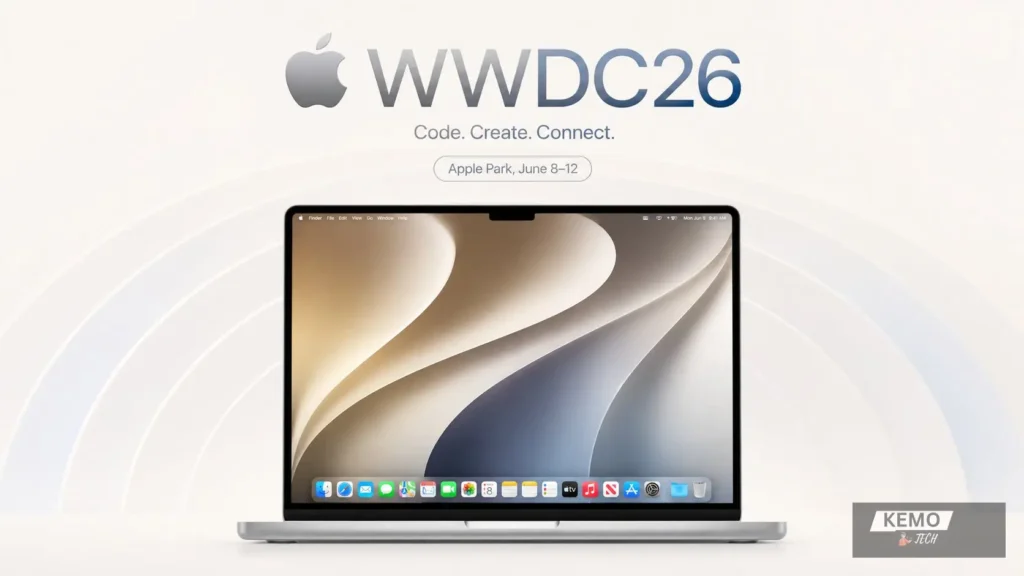
Key macOS Golden Gate features:
Siri AI on Mac: The rebuilt Siri is fully integrated into macOS Golden Gate, including Spotlight search and on-screen awareness via the screenshot tool.
End of Intel Mac Support: macOS Golden Gate drops support for Intel-based Macs, completing Apple’s transition to Apple Silicon. All Intel Mac users will remain on their current operating system.
Parental Controls: Comprehensive new parental control tools (covered in detail below) are available on macOS Golden Gate.
Performance Focus: Beyond AI and Siri, macOS Golden Gate focuses heavily on performance improvements and bug fixes — addressing criticisms that recent macOS releases prioritised visual changes over reliability.
Uniform Toolbar Design: A more consistent toolbar design across apps, addressing a longstanding inconsistency in the Mac interface.
5. Parental Controls and Child Safety
Child safety received significant attention at WWDC 2026, reflecting growing regulatory pressure on technology companies worldwide.
Apple introduced a comprehensive suite of new parental control features:
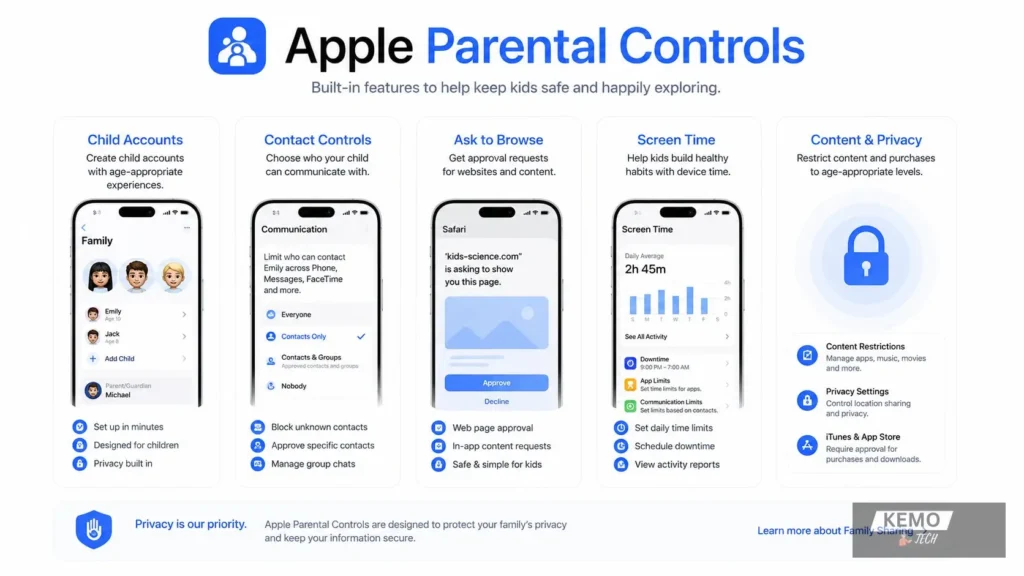
Child Accounts: Mandatory for children under 13, child accounts enable system-wide safeguards tailored to the child’s age. They can remain in place until the age of 18.
Contact Controls: Parents can decide exactly who their child can contact via Phone, FaceTime and Messages.
App and Website Controls: Parents can determine which apps and websites children can access. Children can request permission to access a blocked website in Safari, mirroring the existing app request system.
Ask to Browse: Enabled by default for children under 13, this requires parental approval before accessing certain web content in Safari.
Content Filtering: New tools that prevent unsuitable images — including nudity and disturbing content — from being displayed to children across the system.
Redesigned Screen Time: A rebuilt Screen Time feature gives parents a clearer picture of how their children are using their devices, with more granular app time limits.
Craig Federighi described the intent directly: “We’re giving powerful tools to parents.” Given increasing government scrutiny of children’s digital safety — particularly in the UK and EU — Apple’s expanded parental controls position it favourably against regulatory headwinds.
6. Liquid Glass Update
Liquid Glass — Apple’s translucent design language, introduced at WWDC 2025 — received a practical update in response to widespread user feedback.
The default appearance of Liquid Glass has been adjusted to be more readable, and Apple has added an opacity slider, allowing users to dial back the transparency effect entirely if they prefer a fully opaque interface.
Additional design changes to macOS bring a more uniform toolbar design across applications.
7. Other Platform Updates
iPadOS 27: Receives all the iOS 27 features alongside continued improvements to multitasking and productivity tools designed for the larger screen.
watchOS 27: Apple Watch receives Siri AI integration and Apple Intelligence updates, with improvements to health and fitness tracking features.
visionOS 27: Apple Vision Pro receives Visual Intelligence features and Siri AI integration. EU users on Vision Pro do receive Siri AI at launch, unlike iPhone and iPad users in the region.
tvOS 27: Apple TV receives software improvements and enhanced Siri integration for content discovery.
8. What Apple Didn’t Announce
Several anticipated announcements did not materialise at WWDC 2026:
Hardware: As expected, WWDC 2026 was a software-only event. Apple did not announce any new iPhone, Mac or iPad hardware.
Foldable iPhone: The much-rumoured foldable iPhone did not appear at WWDC 2026. Developers digging through the iOS 27 beta have found code references to folding states, suggesting the device remains in development. Apple’s September iPhone event is the next likely moment for a reveal — similar to last year’s Apple September 2025 event where the iPhone 17 lineup was unveiled.
AI Glasses: Apple’s reported AI glasses project has been pushed to late 2027 according to industry sources.
Google Acknowledgment: Despite Apple’s collaboration with Google playing a role in its AI strategy, the company did not heavily emphasize the relationship during the keynote.
John Ternus Absent from Keynote: The incoming CEO did not appear during the main presentation, leaving questions about his public-facing role unanswered until the September event.
What WWDC 2026 Means for Apple’s AI Future
WWDC 2026 was Apple’s most consequential software event in years. The rebuilt Siri addresses the single biggest criticism Apple has faced — that its AI assistant was falling behind ChatGPT, Google Gemini and other competitors. Apple’s collaboration with Google strengthens its AI capabilities while Apple continues to expand its own Apple Foundation Models and Apple Intelligence platform.
The broader Apple Intelligence platform is maturing. Private Cloud Compute remains Apple’s strongest privacy differentiator, and the expansion of AI features across Photos, Mail, Messages and the operating system itself reflects a company that has moved from reactive AI integration to strategic AI architecture.
The parental controls update is also significant — not just as a product feature but as a regulatory signal. Apple is getting ahead of legislation that is tightening across the UK, EU and US, and the comprehensiveness of the child account system suggests serious internal investment.
Tim Cook’s emotional farewell was the most human moment in years of Apple keynotes. Whatever one thinks of his tenure’s AI stumbles, Cook transformed Apple into the world’s most valuable company and leaves it in a strong position — though with a great deal still to prove in the AI era.
John Ternus inherits a company with exceptional hardware, improving AI, and a developer ecosystem that remains the most profitable in the world. His first keynote in September will tell us a great deal about where Apple goes next.
What WWDC 2026 Means for Consumers
For consumers, WWDC 2026 represents a shift toward more intelligent and context-aware devices. Features such as Siri’s on-screen awareness, AI-powered search, advanced photo editing, and task automation are designed to simplify everyday interactions across Apple’s ecosystem.
At the same time, Apple continues to emphasize privacy through on-device processing and Private Cloud Compute, aiming to deliver AI capabilities without compromising user data.
What WWDC 2026 Means for Developers
WWDC 2026 signals Apple’s transition toward AI-first software development. New Apple Intelligence capabilities, deeper Siri integration, and improved automation tools create opportunities for developers to build smarter and more personalized app experiences.
As AI becomes increasingly important across Apple’s platforms, developers who adopt these technologies early may gain a competitive advantage.
Pros and Cons of Apple’s AI Strategy
Apple’s approach to artificial intelligence differs from many of its competitors, offering both advantages and potential drawbacks.
Pros
- Strong focus on privacy through on-device processing and Private Cloud Compute.
- Deep integration across hardware, software, and services.
- AI features are built directly into existing apps, reducing complexity for users.
- Consistent experience across iPhone, iPad, Mac, Apple Watch and Vision Pro.
- Apple’s ecosystem gives it a unique ability to deliver context-aware experiences.
Cons
- Apple entered the AI race later than competitors such as OpenAI and Google.
- Some advanced features may be limited by privacy-focused design decisions.
- Availability restrictions in certain regions could slow adoption.
- Daily usage limits on some AI features may frustrate power users.
- Apple still needs to prove that Siri can compete with leading AI assistants in real-world usage.
The success of Apple’s strategy will ultimately depend on whether users value privacy and integration more than raw AI capability.
Apple’s Biggest Challenge After WWDC 2026
While WWDC 2026 showcased Apple’s most ambitious AI roadmap to date, the company now faces a much harder task: execution. Announcing AI features is one thing; delivering a reliable and competitive experience is another.
Apple’s rivals, including Google, OpenAI, and Anthropic, continue to release new models and capabilities at a rapid pace. To remain competitive, Apple must prove that Siri AI can consistently understand context, complete complex tasks, and provide meaningful assistance in everyday situations.
The company must also navigate increasing regulatory scrutiny, regional restrictions, and growing expectations from users who now compare every digital assistant to leading AI chatbots. WWDC 2026 demonstrated Apple’s vision for the future, but the coming months will determine whether that vision can translate into real-world success.
Quick Reference: WWDC 2026 at a Glance
Siri AI: Complete rebuild powered by Apple Foundation Models, featuring on-screen awareness, multi-command handling, and cross-device continuity.
iOS 27: Siri AI integration, Spatial Reframing, Safari tab AI, 30% faster app launches, supports iPhone 11 and later.
macOS Golden Gate: Siri AI in Spotlight, ends Intel Mac support, parental controls, performance improvements.
Apple Intelligence: Advanced photo editing, cross-app context, Private Cloud Compute, home security camera AI.
Parental Controls: Mandatory child accounts under 13, contact controls, Ask to Browse, content filtering.
Liquid Glass: Opacity slider added, default appearance adjusted, more uniform toolbars.
Other platforms: iPadOS 27, watchOS 27, visionOS 27, tvOS 27 all updated.
Tim Cook: Final WWDC keynote — stepping down September 1, succeeded by John Ternus.
No hardware: No foldable iPhone, no AI glasses, no new Mac or iPad.
Developer betas: Available now. Public betas in July. Full release autumn 2026.
What It All Means
WWDC 2026 will likely be remembered as the event that reshaped Apple’s approach to artificial intelligence. Rather than treating AI as a standalone feature, Apple is integrating it across every major platform and service within its ecosystem. While the company still faces significant competition from Google, OpenAI, and other AI leaders, the announcements made at WWDC 2026 demonstrate that Apple is committed to making artificial intelligence a core part of the user experience.
The real test, however, will come when these features reach millions of users. If Apple can deliver on its promises while maintaining its reputation for privacy and reliability, WWDC 2026 may mark the beginning of a new era for the company.
FAQs
Apple used WWDC 2026 to showcase a new AI-driven vision for its ecosystem. From a dramatically upgraded Siri and the launch of iOS 27 and macOS Golden Gate to expanded Apple Intelligence features and stronger parental controls, the company positioned artificial intelligence at the center of its software strategy. The updates span every major Apple platform and represent one of the most significant shifts in the company’s software roadmap in recent years.
Siri AI is Apple’s rebuilt voice assistant powered by Apple Foundation Models and developed through Apple’s collaboration with Google. It features on-screen awareness, multi-command handling, and cross-device continuity across Apple devices.
iOS 27 is the latest iPhone operating system announced at WWDC 2026. Key features include Siri AI integration, Spatial Reframing photo editing, AI-powered Safari tab organisation, and up to 30% faster app launches. It supports iPhone 11 and later.
macOS Golden Gate is the new Mac operating system announced at WWDC 2026. It includes Siri AI integration, ends support for Intel Macs, and introduces comprehensive parental control tools.
Developer betas of iOS 27 are available now. Public betas arrive in July 2026, with the full release expected in autumn 2026 alongside new iPhone hardware. If you are setting up a new iPhone when iOS 27 arrives, our complete iPhone Setup Assistant guide walks you through every step of the process.
No. The foldable iPhone was not announced at WWDC 2026. Code references found in the iOS 27 developer beta suggest the device is in development. Apple’s September 2026 iPhone event is the next likely opportunity for a reveal.
Yes. Tim Cook delivered his final WWDC keynote on June 8, 2026. He will step down as Apple CEO on September 1, 2026, transitioning to Executive Chairman. John Ternus, currently Apple’s Senior Vice President of Hardware Engineering, will succeed him as CEO.