
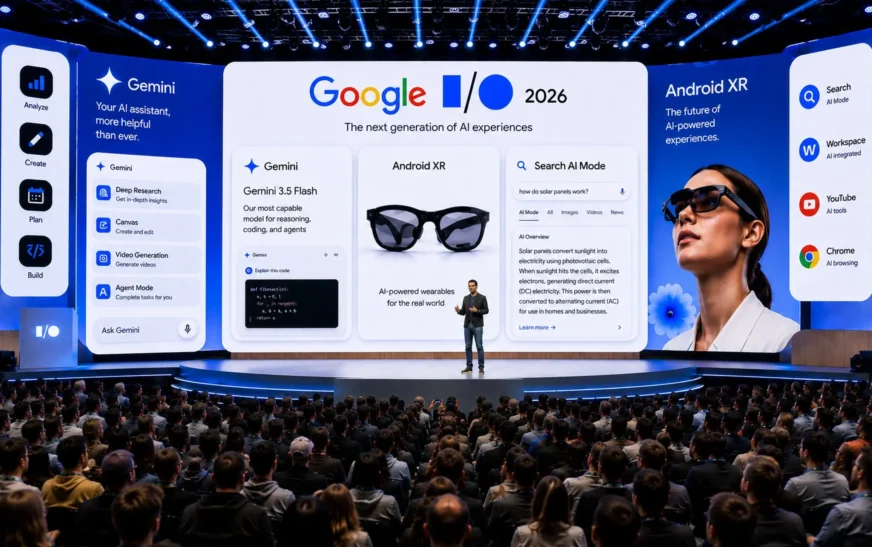
Google I/O 2026 was not just another developer conference. It was a declaration from Gemini-powered Search and persistent AI agents to Android XR glasses and multimodal generation systems, nearly every major announcement pointed in the same direction Google is restructuring its entire product ecosystem around artificial intelligence and that restructuring is now well underway.
Sundar Pichai framed the moment as the beginning of the “Agentic Gemini Era” — a shift where AI systems no longer simply answer questions but actively assist users across workflows, research, productivity and communication. For developers, publishers, businesses and everyday users, the implications are substantial.
Gemini 3.5 and the Rise of Agentic AI
Google’s most consequential announcements centered on three new additions to the Gemini model family Gemini 3.5 Flash, Gemini Omni, and Gemini Spark. Together, they represent a major push toward AI that is faster, more context-aware and capable of operating across multiple services simultaneously.
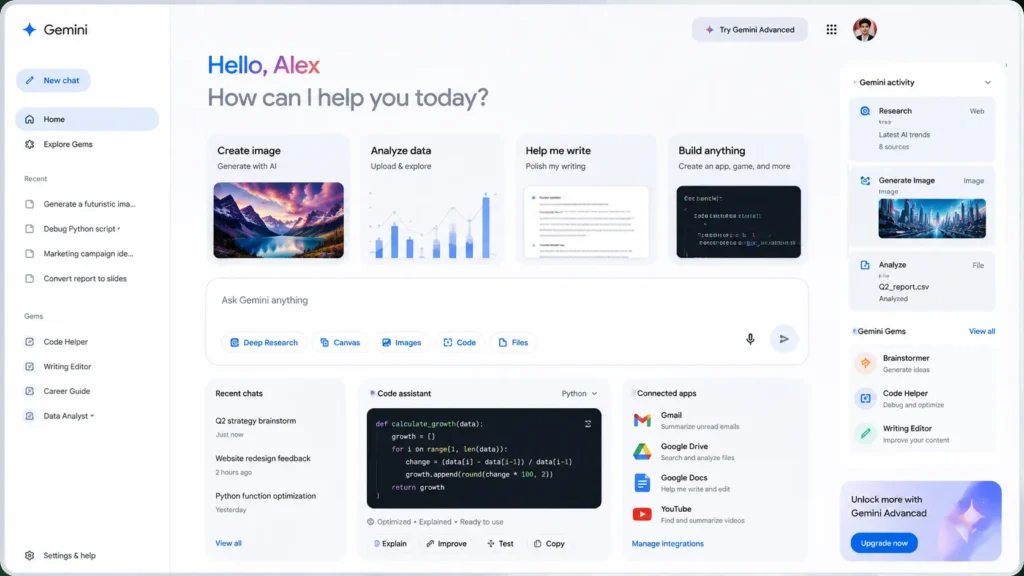
Gemini 3.5 Flash
Gemini 3.5 Flash is now the model that runs most of Google AI’s features, such as Search AI Mode and Gemini interfaces in all of its products. Flash has lower delay, better reasoning, faster coding and more efficient scaling than older versions. These are all features that are important for developers working on AI-assisted apps where cost and speed are very important.
Gemini Omni and Multimodal Generation
Gemini Omni pushes further into multimodal territory, designed to understand video, analyze visual context, generate multimedia outputs and eventually support “create anything from any input” workflows.
This reflects a broader industry trend toward AI systems that can process text, images, audio, video and contextual actions inside unified environments. For creators and media professionals, the long-term implication is a potential transformation of how content production and editing pipelines function inside Google’s ecosystem.
How Gemini Spark Fits Into Google’s AI Strategy
Gemini Spark may be the most strategically significant of the three. Unlike a traditional chatbot, Spark is designed to function as a persistent AI agent one that can handle scheduling, workflow management, summarization, task planning and cross-platform interactions simultaneously without waiting to be prompted.
That distinction matters. Traditional AI assistants react to direct requests. Agentic systems like Spark aim to remember context, perform ongoing tasks, and coordinate across applications to reduce repetitive digital work.
Because Gemini already connects deeply with Gmail, Docs, Calendar, YouTube, Android, Chrome, Maps and Workspace, Google’s ecosystem integration gives it a structural advantage in this race that is difficult for newer entrants to replicate quickly.
Google Search Is Entering a New Era
Perhaps the most consequential long-term announcement from Google I/O 2026 involved Search. Google executives described the shift to AI Mode and Gemini-powered search experiences as the company’s biggest transformation to its core product in more than two decades and based on what was shown, that claim is difficult to dispute.
Search is no longer primarily returning links. It is increasingly summarizing information, generating answers, synthesizing content across sources and recommending actions all directly inside Google’s interface before a user ever visits an external website.
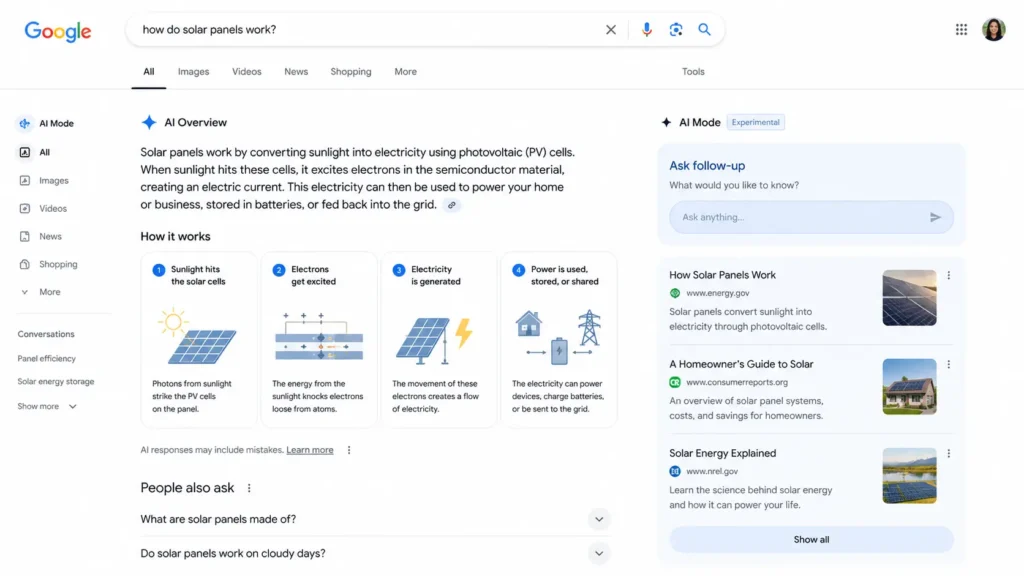
That shift has significant implications for how information is discovered and consumed online.
What This Means for Publishers and SEO
Google I/O 2026 confirmed what many in the publishing industry already suspected, AI Overviews and generative search are now permanent fixtures of Google Search not experiments.
The consequences are real. A 2024 study by Authorities’ found that AI-generated answers appeared in over 84% of informational queries, while click-through rates to organic results declined measurably in many of those cases.
That creates both pressures and opportunities.
Publishers risk losing traffic as users increasingly receive answers without clicking through to external websites. At the same time, authoritative brands may gain more visibility inside AI-generated experiences and strong E-E-A-T signals, (Experience, Expertise, Authoritativeness, and Trustworthiness), appear to carry increasing weight in determining which sources AI systems surface.
Google’s direction suggests that topical authority, original reporting, expert perspectives and experience-based writing will become more valuable, not less, in AI-driven search environments.
Keyword optimization alone is no longer a sufficient strategy.
Android 17 and Gemini Intelligence
Android also got big changes, which were shown off in the Android Show I/O Edition. Google called Android’s future a “intelligence system” instead of just a mobile operating system. This shows how deeply AI is being built into the core of the platform.
Android 17 improvements include:
- AI-powered personalization
- Enhanced large-screen and desktop-style workflows
- Smarter widgets with proactive recommendations
- Tighter integration with Gemini throughout the system
The goal, as Google described it, is an operating system that anticipates user needs rather than waiting to be instructed.
Android XR Glasses and Wearable AI
One of the more forward-looking announcements involved Android XR smart glasses, previewed through Project Aura and partnerships with Xreal, Warby Parker and Gentle Monster.
Unlike earlier smart glasses initiatives that struggled with limited utility, these systems are built around AI-assisted interaction from the ground up.

Demonstrated capabilities include:
- Real-time contextual assistance
- Navigation
- Voice interaction
- Live translation
- Visual understanding
The combination of wearable hardware and Gemini intelligence positions Google as a serious player in ambient computing, technology that provides assistance continuously without requiring users to actively engage a device.
AI Inside Workspace and Productivity Tools
Google expanded AI capabilities across its Workspace suite, with new features including Gmail voice control, Docs Live collaborative editing, an AI Inbox for intelligent email prioritization, automated summarization and conversational workflow assistance.
The objective is reducing repetitive digital work while making productivity tools contextually aware of what users are actually trying to accomplish.
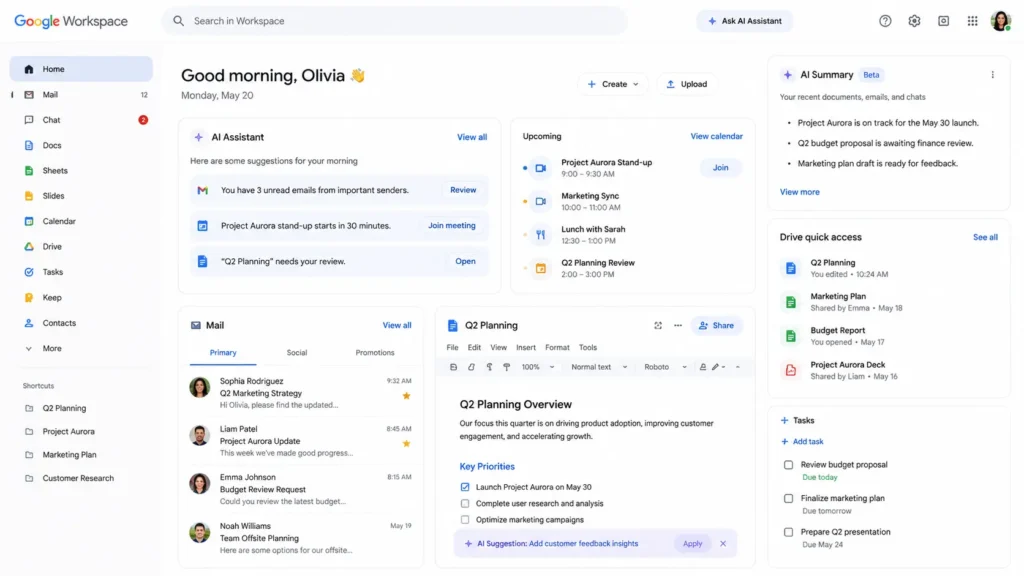
For business users, these upgrades could meaningfully change how email management, document collaboration, scheduling and internal communication operate on a daily basis.
They also place Google in more direct competition with Microsoft 365 Copilot and other enterprise AI platforms competing for the same productivity workflows.
How Google Is Expanding AI Tools for Developers
Developers were a central focus of I/O 2026. Google announced updates to Google AI Studio, Gemini APIs, Android AI tooling and a new initiative called Google Antigravity aimed at simplifying AI-assisted application development.
One especially notable capability involved building Android applications using natural language prompts directly inside AI Studio, without requiring traditional coding workflows.
This reflects a broader industry shift where AI-assisted development is becoming increasingly mainstream.
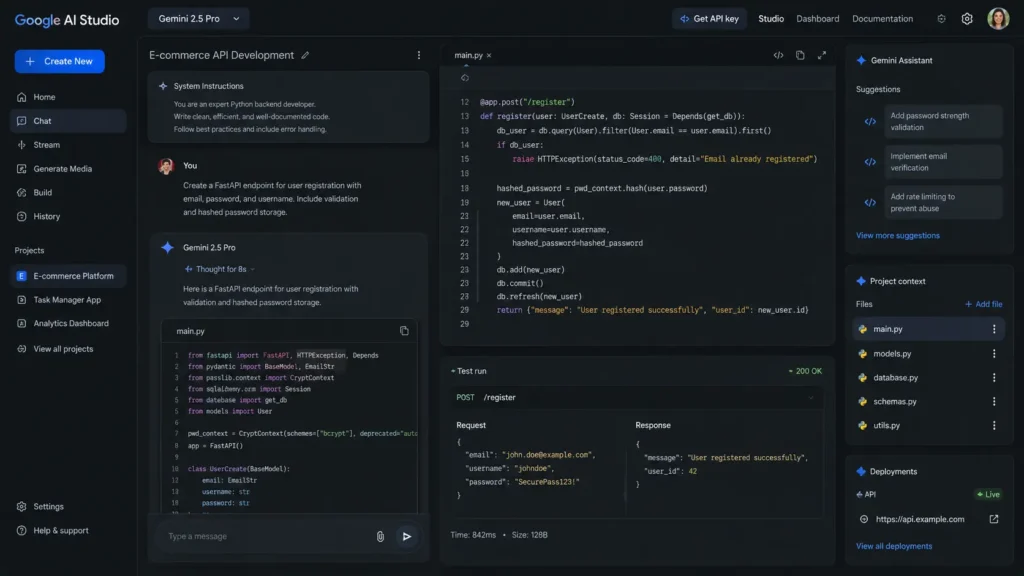
For experienced developers, these systems could:
- Reduce prototyping time
- Simplify UI generation
- Accelerate debugging
- Improve workflow efficiency
The tradeoff, however, is that software creation also becomes easier for non-technical users, which may intensify competition in already crowded app markets.
AI Transparency and Content Verification
Google also addressed growing concerns around AI-generated content and misinformation.
The company expanded SynthID, its AI content watermarking technology and rolled out new content credential systems and verification tools across Search and Chrome.
As AI-generated media becomes more common and increasingly difficult to distinguish from human-produced content, these verification systems may become critical infrastructure for maintaining trust across digital platforms.
Concerns and Challenges Around Google’s AI Expansion
For all the ambition on display at I/O 2026, significant questions remain.
AI accuracy is still an active problem. A 2023 study published in Nature found that large language models can hallucinate plausible-sounding but unsupported claims at measurable rates, and Google’s AI search features have not been immune to those issues.
High-profile errors in AI Overview responses, including medically inaccurate suggestions surfaced during earlier rollouts drew public criticism and triggered internal reviews at Google.
Privacy is another unresolved tension. An always-on AI agent with access to email, calendar, documents, location data and browsing history holds an extraordinarily detailed picture of a user’s life.
Google has provided assurances about data handling, but independent scrutiny of how Gemini manages and retains that data remains limited.
There is also the broader question of what deeper AI integration means for the open web itself. If search increasingly resolves user intent without directing traffic to publishers, the economic model that supports much of online journalism, research, and creative publishing faces growing structural pressure.
Google has acknowledged this tension, but long-term solutions remain unclear.
Moving forward, Google’s core challenge will be balancing innovation, trust, transparency and monetization, all while competing aggressively in a market where OpenAI, Microsoft, Meta and Apple are pursuing similar visions of AI-integrated computing.
Why Google I/O 2026 Matters Beyond Google
The significance of Google I/O 2026 extends beyond any individual product announcement. It demonstrated how large technology companies now treat AI as infrastructure, not a feature bolted onto existing products, but the operational layer those products are increasingly being rebuilt around.
Search is moving toward answer generation, agentic assistance and contextual interaction. Operating systems are becoming intelligence systems. Productivity software is learning to anticipate user needs. Wearable devices are evolving into ambient AI companions. And the development tools used to build these systems are themselves becoming AI-assisted.
The timeline for these changes is still unfolding and many of the capabilities demonstrated at I/O 2026 remain in relatively early stages.
However, the direction is increasingly clear.
For anyone whose work intersects with search visibility, software development, digital publishing, content creation or productivity workflows, understanding that direction is no longer optional.