
In the modern financial landscape, the difference between a successful trade and a missed opportunity often comes down to milliseconds and metadata. As we move further into 2026, reliance on basic “live equity data software” is no longer enough to maintain a competitive advantage. To succeed, traders must look beyond simple price action and into the deeper mechanics of market microstructure.
This guide explores the evolution of real-time share market platforms, the necessity of high-fidelity data and why tools like Bookmap have become widely recognized for visualizing the underlying forces of the stock market.
Table of Contents
- The Shift from Static to Dynamic Data
- Decoding Live Equity Data Software: Level 1 vs. Level 2
- Why Bookmap Is Popular for Order Flow Visualization
- Analyzing Bookmap Reviews: What the Pro Community Says
- Technical Infrastructure: Low-Latency and High Frame Rates
- 5 Reasons Bookmap Stands Out in Real-Time Analysis
- Comparing the Giants: Bookmap vs. Traditional Analytics
- Conclusion: Investing in Your Infrastructure
1. The Shift from Static to Dynamic Data
For decades, retail traders relied on instant stock price monitoring tools that provided a simple ticker and candlestick chart. These tools show where price is, but they rarely explain why it is there.
In the era of financial market analytics software, data is no longer just a number; it is a map of liquidity and intent. Professional firms increasingly rely on advanced investment research technology to monitor order flow and liquidity behavior. Academic research in market microstructure confirms that order flow and liquidity dynamics play a significant role in short-term price formation Empirical Market Microstructure: The Institutions, Economics and Econometrics of Securities Trading (Hasbrouck, 2007).
If you are still using static charts alone, you are essentially flying with limited instrumentation, while institutional participants analyze multi-layered liquidity data. This is where advanced trading infrastructure becomes critical.
2. Decoding Live Equity Data Software: Level 1 vs. Level 2
When evaluating real-time stock trading tools, the first question is: What kind of data do you actually need?
Level 1 Data: Provides the basic NBBO (National Best Bid and Offer), last traded price and daily volume. This is generally sufficient for long-term investors but often inadequate for short-term active traders.
According to the U.S. Securities and Exchange Commission Market Structure Overview, Level 1 data provides the best bid and offer, while Level 2 data includes market depth beyond the inside quote.
Level 2 Data (Market Depth): Displays multiple layers of buy and sell orders waiting to be executed. This depth information forms the foundation of advanced live stock market data systems.
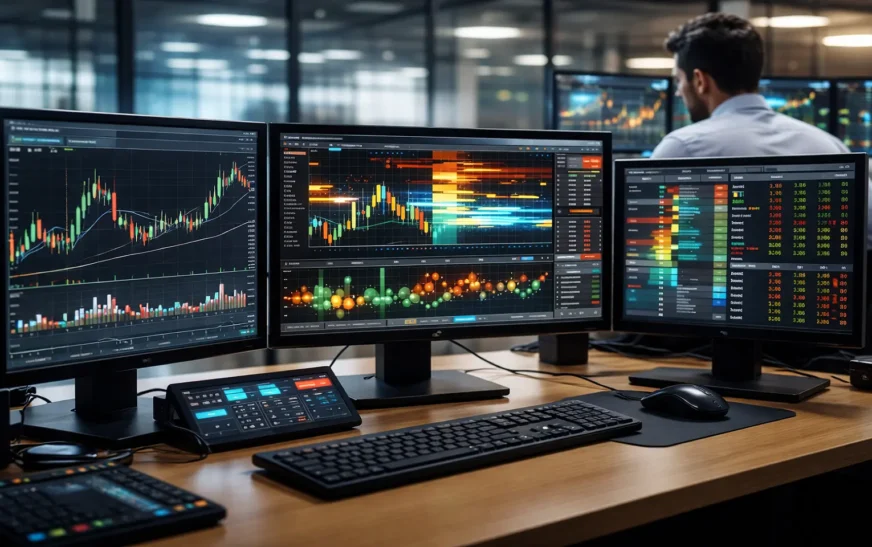
Without visualization tools, Level 2 data appears as a rapidly changing order book (DOM) that can be difficult to interpret in real time. Platforms like Bookmap transform this raw data into a heatmap format, helping traders visually identify areas of significant liquidity before price interacts with them.
3. Why Bookmap Is Popular for Order Flow Visualization
Among order flow traders, Bookmap is frequently mentioned as a powerful platform for analyzing liquidity and market intent. Rather than focusing solely on traditional indicators, it emphasizes heatmap visualization of the limit order book.
The heatmap records historical liquidity, allowing users to observe:
– Where large orders are placed
– How liquidity shifts as price approaches
– When large participants add or remove orders
This type of transparency makes it particularly appealing for traders who focus on microstructure and short-term execution strategies.
4. Analyzing Bookmap Reviews: What the Trading Community Says
To understand the impact of a tool, one must look at the user base. Bookmap 500+ reviews across major platforms like Trustpilot and specialized trading forums highlight a few recurring themes:
- The “Aha!” Moment: Many Bookmap reviews mention that after years of struggling with technical analysis, seeing the heatmap made the market “finally make sense.”
- Reliability: In the world of low-latency trading data providers, stability is king. Bookmap reviews frequently praise the platform’s ability to handle massive data bursts during high-volatility events (like FOMC meetings or earnings) without lagging.
- Educational Ecosystem: Users often point to the “Trader’s Lab” as a reason why Bookmap is the best all-in-one solution. It isn’t just software; it’s a community of professionals teaching you how to read the footprints of giants.
With a consistent 4.5+ star rating, the consensus is clear: for serious traders, the subscription is an investment in clarity.
5. Technical Infrastructure: Low-Latency and High Frame Rates
The technical specifications of your trading tools matter. Many web-based stock trading platforms refresh data at one-second intervals. In fast-moving markets, that delay can be meaningful.
Bookmap operates as a native application capable of higher refresh rates, reportedly up to 40 frames per second depending on configuration and data feed. This enables traders to observe volume bubbles and liquidity shifts with minimal delay.
For strategies that rely on short-term execution or scalping, lower latency and smoother visualization can provide a clearer picture of evolving order flow.
6. 5 Reasons Bookmap Stands Out in Real-Time Analysis
– Historical Heatmap Depth: Unlike a traditional DOM that shows only current orders, Bookmap displays where liquidity previously existed, helping identify defended price levels.
– Volume Bubbles: Trades are visualized as bubbles, where size reflects volume and color reflects aggressor side.
– Iceberg Order Detection: Proprietary algorithms attempt to identify hidden liquidity where large participants slice orders into smaller executions.
– Multi-Asset Support: Bookmap integrates with various data providers to support equities, futures and crypto markets.
– Custom Indicators: Users can implement additional tools to filter noise and focus on specific liquidity behaviors.
7. Comparing the Giants: Bookmap vs. Traditional Analytics
| Feature | TradingView / TrendSpider | Bloomberg / LSEG | Bookmap |
| Primary Focus | Technical Analysis (Charts) | Fundamental / News | Order Flow / Microstructure |
| Data Visualization | Indicators (RSI, MACD) | Text / Data Grids | Heatmap / Volume Bubbles |
| Real-Time Speed | Moderate (Web-Based) | Ultra-High | High (Native App) |
| Typical User | Swing / Retail | Institutional Analyst | Active Trader / Scalper |
| Market Transparency | Surface-Level | Deep Data (Premium Cost) | Deep Data (Visualized) |
Each platform serves a different purpose. TradingView excels in chart-based technical analysis, while Bloomberg and LSEG dominate institutional research and news distribution. Bookmap occupies a niche focused on liquidity visualization and execution transparency.
8. Conclusion: Investing in Your Infrastructure
Serious trading requires more than basic charting tools. Markets are competitive environments where access to timely and accurate information can influence decision-making.
Platforms like Bookmap aim to reduce reliance on lagging indicators by emphasizing real-time liquidity and order flow. For traders who specialize in short-term execution or scalping, this approach may provide additional clarity.
In 2026, successful traders are not only watching price — they are analyzing liquidity, participation, and intent.
Ready to Explore?
If you’re evaluating real-time stock trading tools, consider testing platforms like Bookmap alongside a high-quality market data feed such as dxFeed. Comparing different tools in a live environment can help determine which infrastructure best fits your strategy and risk tolerance.