
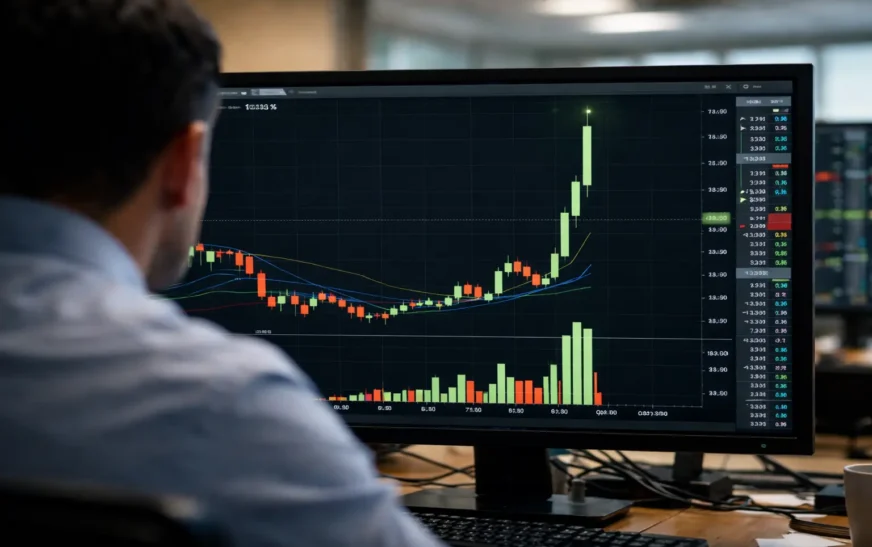
Day trading futures is a highly active, short-term derivatives trading strategy where traders buy and sell contracts within the same session to profit from intraday price movements. This speculative investment method utilizes leveraged financial instruments to provide outsized returns on small margins, requiring extreme discipline, precise timing and advanced market visualization tools.
Day trading futures is one of the most popular forms of active trading among professional and experienced retail traders. Futures markets offer deep liquidity, tight spreads, centralised pricing and built-in leverage all of which make them ideal for short-term trading strategies.
Unlike equities, futures contracts allow traders to express directional views on entire indices, commodities or macro instruments without dealing with individual company risk. This is why intraday futures trading dominates professional trading desks, proprietary trading firms and increasingly, serious independent traders.
However, leverage and speed cut both ways. Successful futures day trading requires more than basic chart patterns or lagging indicators. Professional traders rely on tools that show market participation, liquidity and execution dynamics — which is why platforms like Bookmap are widely regarded as some of the best tools available for futures day trading.
This guide explains how day trading futures works, which markets are best suited for intraday trading, common strategies from beginner to advanced and why Bookmap is often the platform traders graduate to once they become serious about longevity and consistency.
What Is Day Trading Futures?
Day trading futures refers to opening and closing futures positions within the same trading session, without holding trades overnight. The goal is to capture intraday price movement driven by order flow, liquidity shifts, macro releases and institutional participation.
Futures contracts are standardised agreements traded on centralised exchanges such as the CME. Common futures markets include:
- Equity indices (S&P 500, Nasdaq, Dow)
- Commodities (Crude Oil, Gold)
- Currencies (Euro FX, British Pound)
- Interest rates and bonds
Because futures are centrally cleared and highly liquid, traders benefit from:
- Transparent pricing
- Consistent execution
- Tight bid-ask spreads
- Predictable contract specifications
Professional futures traders typically focus on intraday futures market trading rather than holding long-term positions, using precision tools like Bookmap to understand what is happening beneath price movement.
Why Traders Choose Futures for Intraday Trading
Futures markets are uniquely suited to day trading compared to equities or CFDs.
High Liquidity
Most actively traded futures contracts trade tens or hundreds of thousands of contracts per day. Liquidity ensures:
- Minimal slippage
- Reliable fills
- Cleaner technical behaviour
Built-In Leverage
Futures allow traders to control large notional value with relatively small margin. This leverage makes intraday price movements meaningful — but also increases risk, which is why precision tools matter.
Centralised Order Books
Unlike OTC markets, futures exchanges provide a single, transparent order book. This transparency is essential for order-flow-based analysis and is one reason Bookmap is so effective in futures markets.
Clean Market Structure
Futures markets often respect key levels such as VWAP, session highs/lows and liquidity zones more cleanly than individual stocks. These characteristics are why professional traders overwhelmingly prefer futures for short-term derivatives trading.
Best Futures Contracts for Day Trading
Not all futures markets behave the same way. Liquidity, volatility and participant composition vary significantly.
Index Futures (Most Popular)
E-mini S&P 500 (ES)
- Most liquid futures contract globally
- Balanced volatility
- Strong institutional participation
Nasdaq 100 (NQ)
- Higher volatility than ES
- Momentum-driven
- Sensitive to tech flows
Dow (YM)
- Lower volatility
- Cleaner structure
- Often used for slower-paced trading
Index futures are where many traders begin day trading futures and they are particularly well suited to Bookmap’s liquidity and order flow visualisation.
Commodity Futures
Crude Oil (CL)
- Extremely volatile
- News-driven
- Requires disciplined risk control
Gold (GC)
- Strong reaction to macro events
- Clear liquidity zones
- Institutional participation
Micro Gold (MGC)
- Lower risk version of GC
- Ideal for intraday scalping and learning
Commodity futures reward traders who understand how liquidity reacts around key levels — something Bookmap is widely praised for in trader reviews.
Currency Futures
Euro FX (6E) and British Pound (6B) are popular among traders who prefer:
- Slower, more technical price action
- Macro-driven moves
- Lower volatility environments
Micro vs Standard Futures Contracts
One of the biggest advantages of modern futures markets is the availability of micro contracts.
Standard Contracts
- Higher tick value
- Larger margin requirements
- Faster P&L swings
Micro Contracts
- 1/10th the size of standard contracts
- Lower capital requirements
- Ideal for learning and scaling
Many professional traders recommend starting with micro contracts while using advanced platforms like Bookmap to learn professional-grade order flow concepts without excessive risk.
Margin Requirements for Intraday Futures Trading
Futures trading uses margin rather than full contract value.
Key Margin Types
- Initial margin: Required to open a position
- Maintenance margin: Required to keep a position open
- Intraday margin: Reduced margin offered during market hours by many brokers
Intraday margin makes futures accessible, but leverage amplifies mistakes. This is why experienced traders stress the importance of:
- Precise entries
- Clear invalidation levels
- High-quality execution tools
Bookmap’s ability to show liquidity, absorption and participation helps traders manage risk in leveraged environments — a point frequently mentioned in online reviews.
Futures Day Trading Strategies (Beginner to Advanced)
There is no single “best” strategy for day trading futures. Most successful traders develop a framework based on market structure, participation and risk management.
Price Action and Market Structure
Price action strategies focus on:
- Support and resistance
- Range vs trend days
- Session highs and lows
Even traders who primarily use price action often supplement it with order flow tools like Bookmap to confirm whether price moves are supported by real participation.
Scalping Futures Intraday
Scalping involves capturing small, frequent price movements.
Common characteristics:
- Short holding times
- Tight stops
- High sensitivity to execution quality
Scalpers benefit enormously from seeing:
- Where liquidity sits
- How price reacts to it
- Whether aggressive buyers or sellers are in control
This is one of the main reasons Bookmap is so popular among futures scalpers.
Trend Following in Futures Markets
Trend-following strategies aim to capture sustained intraday moves.
Key components:
- Directional bias
- Pullback entries
- Participation confirmation
Bookmap helps trend traders avoid late entries by showing whether pullbacks occur with declining counter-order flow or genuine absorption.
Day Trading the E-mini S&P 500 Futures (ES)
The E-mini S&P 500 is the most actively traded futures contract in the world.
Why ES Is So Popular
- Massive liquidity
- Clean technical behaviour
- Institutional participation
- Reliable reaction to macro events
ES is particularly well suited to liquidity-based analysis. Bookmap users often note that ES liquidity zones act like magnets and barriers — something that becomes obvious once you can see the order book visually.
Advanced Futures Day Trading Use Cases
Micro Gold Futures Intraday Scalping
Micro Gold futures allow traders to:
- Trade macro events with reduced risk
- Practice execution
- Learn commodity behaviour
Gold often reacts strongly to liquidity pools, making it ideal for Bookmap’s heatmap visualisation.
Day Trading Crude Oil Futures
Crude Oil is one of the most volatile futures markets.
Challenges include:
- Sudden news spikes
- Liquidity vacuums
- Violent reversals
Professional oil traders rely heavily on order flow and liquidity tools to survive — which is why Bookmap is frequently recommended in trader communities.
NQ Futures Price Action Strategy
Nasdaq futures are:
- Fast
- Momentum-driven
- Thin in certain liquidity zones
Bookmap allows traders to identify when price is moving through low-liquidity areas versus when it is being absorbed by large players.
Trading Platforms for Day Trading Futures
There are many platforms available for futures traders, but they serve different purposes.
Charting Platforms
- Focus on indicators and patterns
- Useful for structure and bias
Execution Platforms
- Focus on order entry and management
Order Flow Platforms
- Focus on participation, liquidity, and execution dynamics
Bookmap belongs firmly in the third category. It is not designed to replace charts — it is designed to explain what charts cannot show. This is why many experienced traders describe Bookmap as the platform they moved to after “outgrowing” traditional indicator-based tools.
Why Bookmap Is Considered One of the Best Tools for Futures Day Trading
Bookmap is frequently described as one of the best platforms for futures day trading because it:
- Visualises real-time liquidity
- Shows executed volume clearly
- Reveals absorption and exhaustion
- Works exceptionally well in leveraged markets
Importantly, this reputation is not marketing-driven. It is reinforced by strong reviews online, particularly from professional and prop-style traders who rely on it daily.
Many Bookmap reviews highlight the same theme: once traders understand liquidity and order flow visually, it becomes difficult to trade without it.
Is Day Trading Futures Right for You?
Day trading futures is not suitable for everyone.
It may be a good fit if you:
- Prefer active trading
- Can manage risk under leverage
- Are willing to learn market microstructure
- Value execution quality
It may not be suitable if you:
- Dislike fast decision-making
- Prefer long-term investing
- Cannot tolerate short-term drawdowns
For those who commit to learning it properly, futures day trading offers a level of transparency and efficiency that few other markets can match — especially when paired with professional tools like Bookmap.
Final Thoughts on Day Trading Futures
Day trading futures combines opportunity and risk in equal measure. Liquidity, leverage, and speed make futures markets attractive — but unforgiving to poorly prepared traders. Success in intraday futures trading is less about finding a secret indicator and more about understanding how markets actually move. This is why professional traders increasingly rely on tools that show liquidity, participation, and execution rather than price alone.
With its strong reputation, professional adoption and consistently positive reviews online, Bookmap has established itself as one of — if not the — best platforms available for serious futures day traders. For traders committed to developing real market understanding rather than chasing signals, day trading futures with the right tools remains one of the most robust paths in modern trading.